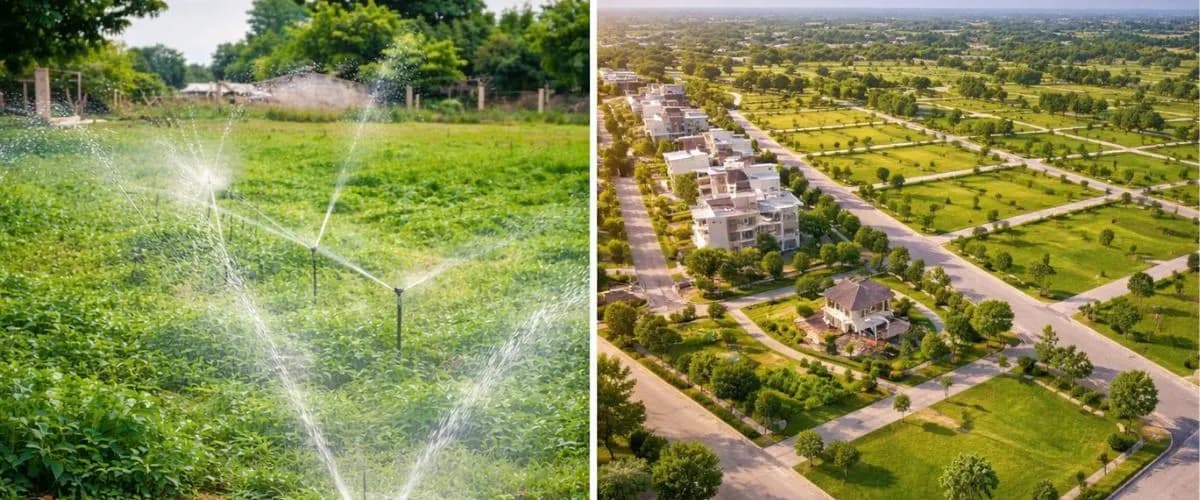
Land in Hisar is not what it used to be. And that is either the best news you have heard all year, or the beginning of a very expensive mistake, depending entirely on which type of plot you buy.
Someone close to this beat once described the dilemma well: walking through the outskirts of Hisar felt like standing at a fork in a road that did not have signposts. On one side, open farmland selling for a fraction of its potential value. On the other, plotted residential colonies with legal approvals, rising prices, and the very real possibility of a house being built on them someday soon. Both looked like opportunity. Both carried completely different rules.
That fork is exactly where many investors in Hisar find themselves today. And the gap in understanding between agricultural plot investment in Hisar and residential plot investment in Hisar is wide enough that the wrong choice can stall your money for years, or worse, leave you holding land you cannot legally use.
This article walks through every dimension of that choice, clearly and without cutting corners.
Why Hisar Land Is Attracting Serious Investor Attention Right Now
Hisar is no longer just a cattle-fair city. It has been identified as one of Haryana's growth nodes, driven by expanding industrial zones, a functional airport, improving road connectivity toward Delhi and Chandigarh, and a medical university that brings population and demand. The Haryana government has actively listed Hisar among cities earmarked for affordable residential plot schemes under HSVP (Haryana Shehri Vikas Pradhikaran), formerly known as HUDA.
What that means practically is this: land around Hisar is being watched. Circle rates are being revised. Demand from both end-users and investors is picking up. And the distinction between land use categories in Hisar has never mattered more.
"The most expensive mistake in real estate is not buying the wrong property. It is buying the right land in the wrong legal category."
Agricultural Land in Hisar: What It Actually Means for an Investor
Agricultural land in Haryana is classified under the revenue records as land meant for farming. It typically shows up in the Jamabandi (land revenue records) with agricultural use noted. In principle, you can buy it. You can grow crops on it. But you cannot build a house on it, open a shop, or run a business, without first converting it.
That conversion is called a Change of Land Use (CLU), and it is managed by the Directorate of Town and Country Planning (DTCP), Haryana. Without a CLU, any construction on agricultural land is unauthorised and can be demolished. That is not a hypothetical. It has happened across Haryana repeatedly.
The appeal of agricultural plots in Hisar is understandable. They are significantly cheaper per acre than approved residential plots. In peripheral villages around Hisar, agricultural land can be acquired at prices that feel almost too good. And if the city expands toward that land, and CLU becomes possible, the return on that bet can be exceptional.
The risk is that this scenario depends heavily on the Master Plan. Haryana's DTCP controls zone designations, and land sitting in an agricultural zone of the Final Development Plan cannot simply be converted on demand. The application goes through the District Town Planner, and approval timelines can stretch from months to years, with no guarantee of success.
Who buys agricultural land around Hisar?
Typically, it is investors with a long horizon, say seven to twelve years, who are comfortable with illiquidity. Farmers who want to hold ancestral land as a passive asset. Or buyers hoping to establish farmhouses, which require their own CLU under Haryana's farmhouse policy. It is not an ideal vehicle for someone expecting growth in two or three years.
Residential Plots in Hisar: Predictable, Legal, and Ready to Build
A residential plot in Hisar sits in a designated residential zone, carries a DTCP licence or HSVP approval, and can be registered, built upon, and sold without needing any additional permissions. The title is clearer. The exit is faster. And a bank will actually lend against it.
HSVP has been actively developing sectors in Hisar and allotting residential plots through both open market and scheme-based routes. Private developers with RERA registration also offer plotted colonies with necessary approvals. The price is higher than agricultural land, but the legal clarity is not a small thing. It is the difference between owning land and owning land you can actually use.
The CLU Process: How Conversion From Agricultural to Residential Actually Works
For those who buy agricultural land and want to eventually convert it, the CLU process in Haryana involves submitting an application in Form CLU-I to the District Town Planner, along with a survey plan, sale deed copy, revenue records, a Genuineness Certificate from the DC's office, and if near an agricultural zone, a No Objection Certificate from the Haryana State Pollution Control Board.
The conversion fee in Haryana for agricultural to residential use is Rs 10 per square metre, but that number is the small part. The real cost is time. Cases not covered by a published development plan go to the government level for decision. And even after CLU approval, the collector rate multiplier for a residential plotted colony is three times the agricultural base rate, which affects stamp duty significantly.
Key Legal Point: No CLU, no construction. Haryana's DTCP has clear authority under the Haryana Development and Regulation of Urban Areas Act, 1975. Building on agricultural land without conversion permission is classified as unauthorised development and subject to demolition proceedings. Always verify zone classification in the published Development Plan before purchasing.
Real-World Scenarios: Two Buyers in Hisar
Consider two investors looking at land in Hisar's expanding periphery.
The first buys five acres of agricultural land in a village 8 kilometres from the city centre at a low per-acre price. His plan is to wait. He expects Hisar to expand, the Master Plan to be revised, and CLU to become possible. Maybe it does. Maybe in ten years he is sitting on a transformed asset. But for those ten years, that land earns nothing except a modest rental from a farmer, and he cannot build, sell easily, or borrow against it.

The second buys a 200-square-yard HSVP-approved residential plot in a developed sector within Hisar at a significantly higher price per unit. She registers it, pays stamp duty, and holds it. Within three years she builds a small house, rents it out, or resells it to someone who values the legal clarity. The paperwork was clean, the exit was predictable.
Neither investor is wrong. They have different timelines, risk appetites, and goals. What would be wrong is the first investor expecting a quick return, or the second one comparing per-acre prices with agricultural land and feeling overcharged without understanding why the difference exists.
Mistakes That Keep Repeating in the Hisar Land Market
Buyers sometimes purchase agricultural land near Hisar on the verbal assurance of a broker that CLU is "easy" or "already in process." It is worth knowing that CLU approval is never guaranteed, and a broker cannot promise what a government authority decides. Get any claim verified directly from the DTCP or District Town Planner's office before signing.
Another mistake is ignoring the Jamabandi. The revenue records in Haryana, accessible through the official Jamabandi and Web-Halris portals, tell you the land use classification, owner history, and any encumbrances. Skipping this step is not a shortcut. It is the kind of shortcut that surfaces in a courtroom later.
There is also the matter of NRI and non-farmer buyers purchasing agricultural land. In Haryana, there are specific restrictions on who can buy agricultural land. Non-agriculturists in certain categories may face legal complications. Consulting a local property lawyer before any agricultural land purchase in Haryana is not optional.
Pro-Level Thinking Before You Commit
Check whether the land falls within a controlled area as per the current Development Plan. Hisar has a designated Master Plan zone, and land falling inside the controlled area has different conversion possibilities than land outside it.
For residential plots in Hisar, verify the RERA registration number of the developer and check whether the licence from DTCP Haryana is current. A plot in an unlicensed colony carries risks similar to agricultural land despite looking residential on paper.
Also factor in location within Hisar's growth corridors. Plots near the airport zone, the emerging industrial belts, or the sectors where HSVP is actively developing infrastructure tend to hold and grow value more reliably than peripheral locations, regardless of land category.
One thing worth knowing: Haryana revised its circle rates effective April 2026. Agricultural land being converted to residential use now carries a CLU multiplier of three times the agricultural base rate for stamp duty purposes. That changes the cost calculation meaningfully for anyone considering buying agricultural land and converting it.
Closing Thought
There is something quietly seductive about agricultural land. The price, the open space, the possibility baked into it. But possibility without legal permission is just possibility. And in real estate, especially in a city moving as quickly as Hisar, the gap between a possible return and a legally realisable return is where most investor disappointment actually lives.
Residential plots in Hisar cost more per unit. That cost is not arbitrary. It reflects legal approvals, infrastructure development, and the simple fact that you can build on them tomorrow. That is worth something. Precisely how much it is worth depends on what you are actually trying to do with the land, and on what timeline.
Know what you own. Know what it allows. Everything else follows from there.
FAQs
Can I build a house on agricultural land in Hisar without any permissions?
No. Building on agricultural land in Haryana without a valid CLU from the DTCP is unauthorised and can be demolished by authorities. You must obtain CLU approval before any construction, regardless of the land's location relative to the city.
Is agricultural land cheaper than residential plots in Hisar? By how much?
Generally, yes. Agricultural land on the periphery of Hisar can cost significantly less per acre than DTCP-approved or HSVP residential plots within developed sectors. However, the CLU multiplier for conversion adds three times the agricultural collector rate in stamp duty costs, which narrows the apparent gap when factoring in conversion expenses and legal costs.
What documents should I check before buying a residential plot in Hisar?
Verify the DTCP licence or HSVP allotment papers, RERA registration of the developer, a 30-year encumbrance certificate (EC), the Jamabandi land records via the official web portal, and confirm the zone classification in Hisar's current Master Plan or Development Plan. For HSVP plots, the allotment letter and payment schedule from HSVP are the primary documents.
Who can buy agricultural land in Haryana?
Haryana has restrictions on agricultural land purchases. In many cases, non-agricultural individuals or entities face legal limitations. The specific rules depend on the land classification, location, and buyer category. Consulting a registered local property lawyer before purchasing agricultural land in Haryana is strongly advised to avoid legal complications post-purchase.
How long does the CLU process take in Haryana?
There is no fixed timeline. Cases that fall under a published Development Plan are processed at the Director level in the DTCP, which can take several months. Cases outside a published plan go to the state government for decision. In practice, the process often takes one to several years, with no guaranteed outcome.
Which is better for someone who wants to build a house in the next two to three years?
A DTCP-approved or HSVP residential plot is the only realistic choice for that timeline. Agricultural land in that timeframe would require CLU approval, which is neither quick nor guaranteed. For a goal of building within three years, residential plots are the clear, practical option.